For new players 5 min read
Your first chess tournament
From online games to a seat at the board
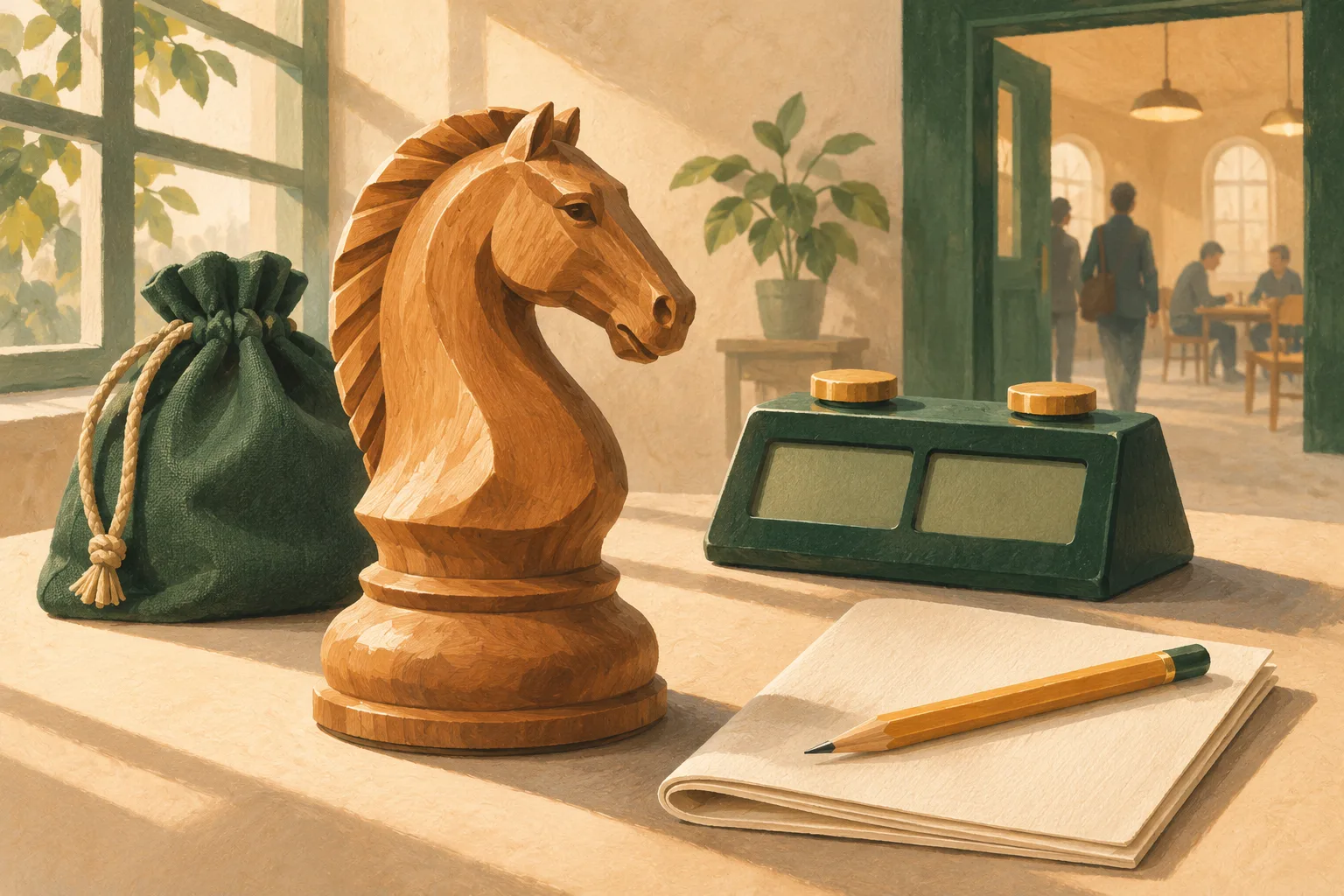
You know how the pieces move. The unfamiliar part is everything around the game: signing up, finding your board, handling a clock and knowing when to ask for help. Here is a practical route from choosing an event to finishing your first round.
1. Choose a manageable first event
Start with the announcement, often called the Ausschreibung in Germany. Look for who can enter, the venue, the number of rounds, the time control, the fee and the registration deadline. An event described as an Open can still have age, rating or membership conditions.
For a first outing, a nearby event with a clear schedule is a practical choice. A very fast game gives you less time to handle unfamiliar pieces and a clock. A longer game gives you more thinking time but can make for a long day. Choose the pace you would enjoy practising beforehand.
Use SchachPortal to compare events in Berlin and Brandenburg, then open the organiser’s source. A missing entry condition is a question to ask, not a promise that everyone is eligible.
2. Register and confirm your place
Follow the organiser’s stated registration method. Send the requested player details, choose the correct section and check how payment works. Look for an acknowledgement or an entry in the participant list. If the confirmation is unclear, contact the organiser before travelling.
If a FIDE ID is required, arrange it in advance through the appropriate federation. A FIDE ID identifies you; it does not mean you already have a rating. You can ask the organiser which route applies to you.
Saving an event in SchachPortal helps you plan. It does not submit an entry or prove that the organiser has accepted it. Keep your confirmation and payment information together.
Sources & further reading: [2]
3. Practise the small things at home
Play a complete practice game on a physical board. Get used to seeing diagonals from your seat, making a move and then pressing the clock. Try the time control announced for your event rather than relying only on your usual online blitz routine.
A control written as 15+10 normally means 15 minutes per player plus 10 seconds added for each move. It is not a 15-minute limit for the whole game. Check any extra stages in the announcement and ask the arbiter to explain an unfamiliar clock setting.
If your event requires notation, practise recording both sides’ moves on paper. This is a useful preparation habit even if your first event does not require it. You do not need a new opening repertoire the night before: sleep, a clear journey and a few familiar positions are a better last-minute plan.
4. Arrive, check in and find your board
Plan to arrive before the organiser’s check-in deadline, with time to find the entrance and toilets. The first-round start time and the check-in deadline may be different. Tell the desk that you are new, ask where pairings appear and confirm any equipment you need.
A pairing tells you the round, your opponent, your colour and your board number. Find your own name, check all four details and go to the numbered board. Pairings may be posted on paper or online; do not assume that your seat stays the same throughout the day.
Before play begins, ask how to get the arbiter’s attention and how results are reported. Sort out phones and smartwatches according to the event’s instructions. Silent mode is not permission to keep a device with you.
Sources & further reading: [1]
5. Know the essentials at the board
Greet your opponent and settle in. Give yourself a moment to check the board and clock before the round starts. The aim is to play a fair game, not to look experienced.
- Touch-move: deliberately touching a piece can commit you to moving or capturing it if legal. To adjust a piece, announce your intention first, on your turn.
- Use the same hand to move and press the clock.
- Classical play normally requires recording moves; rapid and blitz generally do not. Ask about the rules for your event.
- For a problem or claim, call the arbiter. Pause the clock when necessary to seek assistance; do not decide a disputed penalty yourself.
Sources & further reading: [1]
6. Finish the round and reset
Make sure you and your opponent agree on the result, then follow the event’s reporting procedure. If something is disputed, leave the position available and get the arbiter. Move any analysis or conversation away from games still in progress.
Check the next round’s time before taking a break. Losing a game does not usually end your tournament: in a Swiss event, you normally keep playing the scheduled rounds. If you need to withdraw or miss a round, tell the organiser rather than simply leaving.
After the event, keep one or two positions you found difficult and one thing you handled well. Your first tournament is also practice in the routine. An online rating is not a reliable prediction of your first over-the-board result.
Before you leave home
Read the announcement once more the day before you travel. If there is a late change, the organiser’s current information matters more than an older saved copy.
- Registration confirmation, correct section and payment checked
- Venue, check-in deadline, first round and journey saved
- Pen, water, a quiet snack for breaks and an extra layer packed
- Board or clock packed only if the organiser asks you to bring them
- Device-storage instructions and a plan for the journey home checked
Sources & further reading
Rules and rating information checked on 13 November 2026. Follow the current official rules and the event’s published conditions; the arbiter decides claims at your tournament.