At the board 3 min read
Illegal moves, clock problems and time running out
Keep the position, stop the argument, call the arbiter
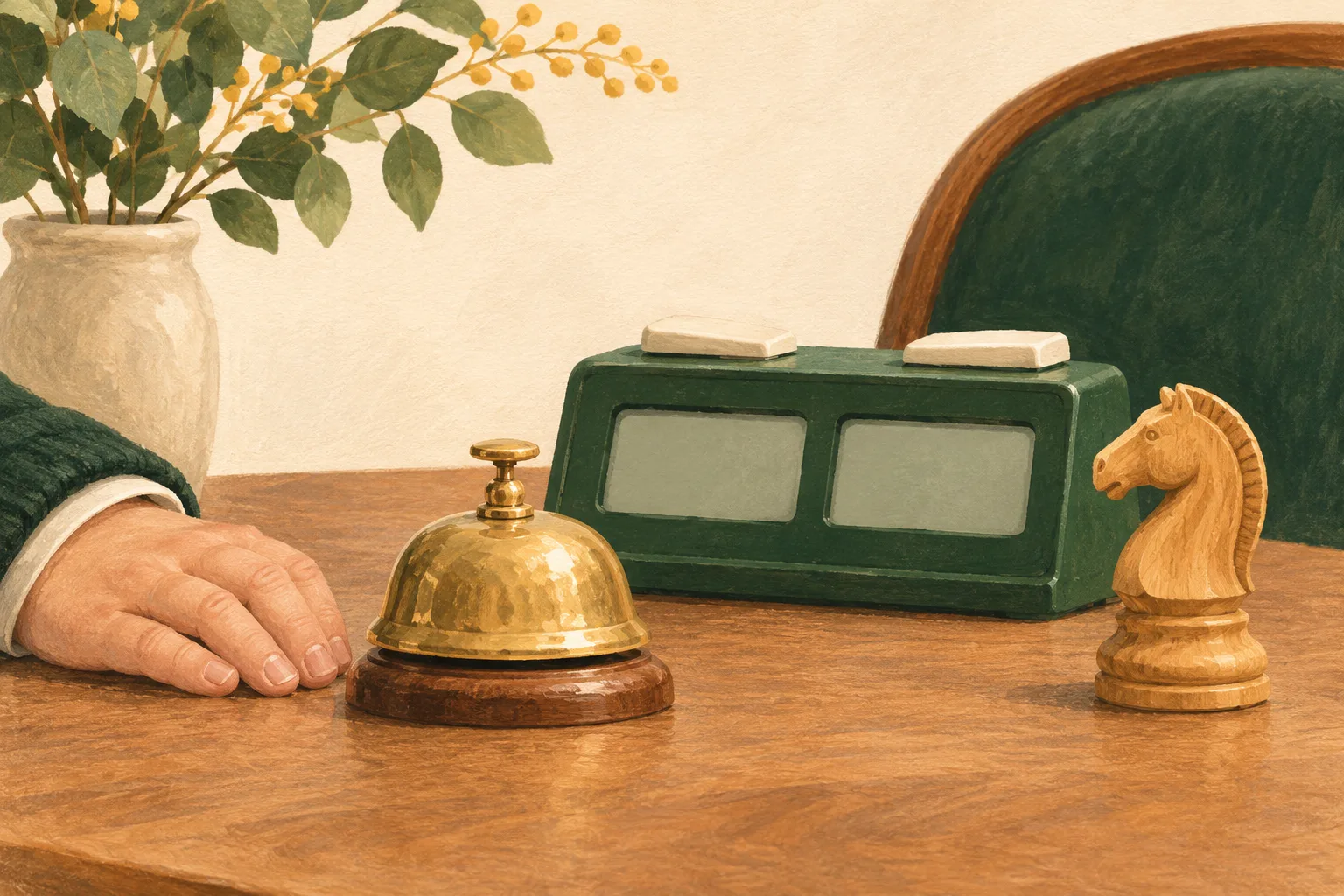
You do not need to administer a penalty yourself. Your job is to notice the problem promptly, preserve the position and bring in the arbiter. Playing another move can change which claims are available.
How to ask for help
Raise your hand or call “Arbiter”. Pause the clock when necessary to seek assistance and explain the problem briefly. Leave the pieces and clock settings available for inspection; do not reconstruct the game on the playing board yourself.
For a faulty display, wrong setting or knocked-over pieces, ask for a correction. The arbiter decides whether times or move counters need adjustment. Pausing the clock is for a valid reason, not extra thinking time.
Sources & further reading: [1]
What is a completed illegal move?
A move that leaves your king in check is illegal. A discovered illegal move is normally restored to the position immediately before it, or the last identifiable earlier position. Touch-move can still constrain the replacement move.
For the relevant penalty, an illegal move is completed when the player presses the clock. Pressing without making a move, or using two hands for one move and then pressing, is also treated as an illegal move under the Laws.
If a pawn reaches the last rank and the player presses without replacing it, the move is illegal and the pawn is replaced by a queen. If the required piece is missing, pause and ask the arbiter before pressing to complete the move.
Sources & further reading: [1]
The procedure depends on the playing rules
Under the Competition Rules, the first completed illegal move gives the opponent two extra minutes. A second by the same player loses, unless the opponent cannot possibly checkmate, in which case it is a draw.
Under ordinary rapid rules—and blitz using those rules—the relevant time penalties are one minute. An illegal move must be acted on before the opponent makes the next move. Otherwise it generally stands under that procedure.
Sufficiently supervised events can use the Competition Rules instead; supervised blitz has its own conditions. Check the announced rules with the arbiter. “One illegal move always loses in blitz” is not a dependable rule.
Sources & further reading: [1]
When time runs out
Normally, failing to make the required moves within the allotted time loses. But the result is a draw if the opponent could not checkmate by any possible legal sequence. This is about possibility, not whether a mate can be forced against good defence.
A bare king cannot checkmate. Other material situations need care: do not decide solely by counting pieces. Call the arbiter to establish the result. If the game already ended by a legal checkmate or another immediate ending, a later clock press does not undo it.
Sources & further reading: [1]
Sources & further reading
Rules and rating information checked on 13 November 2026. Follow the current official rules and the event’s published conditions; the arbiter decides claims at your tournament.